In this article
- What is ISO 27001, and what does it cover at a logistics provider?
- Benefits for you and for your clients
- How does ISO 27001 fit with supply chain requirements?
- How to verify your operator's certification
- Comparison: certified vs. non-certified company
- Frequently asked questions
- Why choose Global-TALKE?
In logistics and storage, safety does not depend only on how goods are handled; it also depends on how the information that travels with them is protected: orders, contracts, technical and regulatory documentation, client and supplier data. The ISO 27001 certificate is the international reference for implementing an Information Security Management System (ISMS) capable of protecting those assets with rigour and transparency.
What is ISO 27001, and what does it cover at a logistics provider?
ISO 27001 sets out the requirements for identifying risks, applying controls and continuously improving information security. From a certified logistics and storage company you can expect:
- Governance and accountability: clear policies and roles on who decides and who answers for security
- Asset management and information classification: inventory, labelling and handling according to criticality
- Access control: least-privilege access, periodic reviews and segregation of duties
- Physical and environmental security: access control to warehouses/offices, CCTV, electrical protection, climate control and redundancies
- Cryptography and secure communications: encryption of data at rest and in transit, segmented networks
- Supplier management: assessment and security clauses across the supply chain
- Business continuity: backups, disaster recovery and operational continuity plans
- Incident management: detection, response, logging and post-incident learning
Benefits for you and for your clients
- Verifiable trust: your data and your clients' data are protected under standards audited by an independent body.
- Lower operational risk: less likelihood of disruption from cyberattacks, errors or information leaks.
- Easier regulatory compliance: alignment with data protection requirements and sector frameworks (especially relevant in chemical logistics).
- Transparency and traceability: robust document control that makes it possible to demonstrate compliance to auditors and clients.
- Competitive advantage: certification sets your operator apart and adds security to your own value proposition.
How does ISO 27001 fit with supply chain requirements?
In demanding environments —such as chemical product logistics and storage— information security complements operational safety. ISO 27001 coexists with quality and environmental management systems (ISO 9001, ISO 14001), health and safety (ISO 45001) and technical requirements (for example, ADR for the transport of dangerous goods). The result is a comprehensive approach: safe goods and protected information.
How to verify your operator's certification
Before awarding a contract, you can request and review:
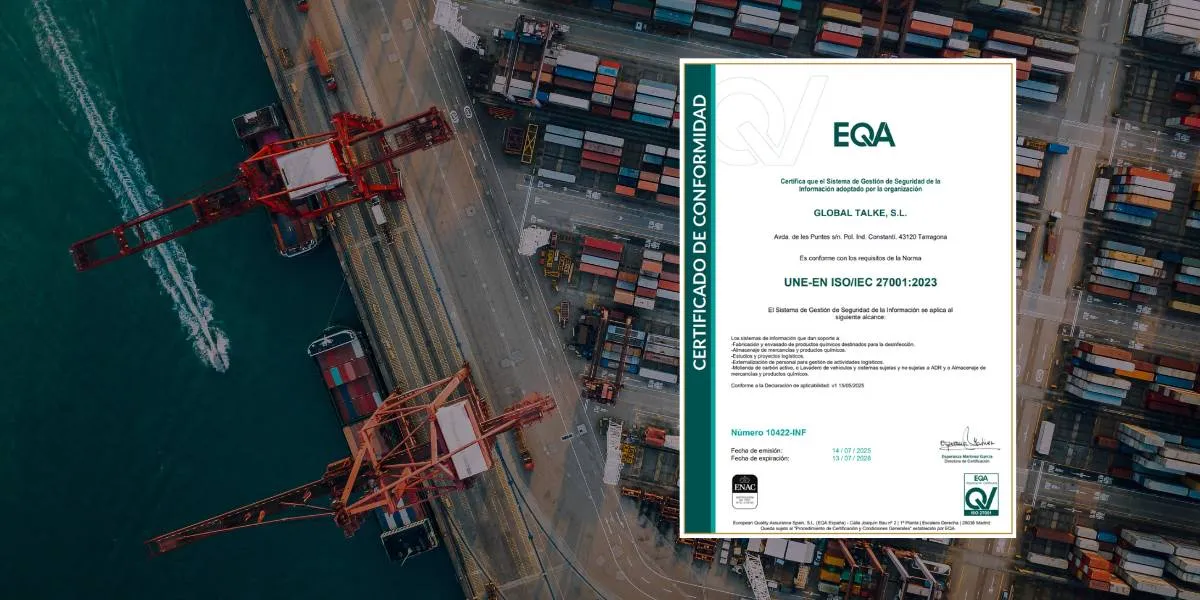
- Certificate number and certification body: check that it is a recognised certification body
- Scope: make sure it includes the services and sites you will use (warehouses, offices, systems)
- Issue and expiry dates: confirm it is in force and check the schedule of surveillance audits
- Statement of Applicability (SoA): the list of ISO 27001 controls adopted by the operator
- Key policies: available to clients (security, continuity, incident management)
Comparison: certified vs. non-certified company
| Aspect | ISO 27001-certified company | Non-certified company |
|---|---|---|
| Risk management | Formal methodology, reviews and records | Ad hoc practices, limited evidence |
| Access controls | Least-privilege principle and audits | Manual provisioning, risk of excess rights |
| Continuity | Tested backups and recovery plans | Occasional copies, no regular testing |
| Suppliers | Assessed and contractually bound on security | Generic or non-existent clauses |
| Incidents | Defined response and notification process | Reactive handling, little traceability |
Frequently asked questions
Does the certification apply to the whole company or to specific sites and services?
It depends on the scope. Check that it includes the warehouses, processes and systems that affect your contract.
Does ISO 27001 improve the continuity of the logistics service?
Yes. It requires plans and tests that reduce recovery time after incidents, which protects your operations and inventory.
What changes for you as a client when working with a certified operator?
You gain visibility, evidence of compliance and a common framework for audits, assessments and contractual requirements.
Is it relevant if I manage dangerous goods?
Especially so. Technical and regulatory documentation requires protection equivalent to that of the goods themselves, to avoid risks and penalties.
Why choose Global-TALKE?
If you value working with an operator that protects information with the same rigour with which it handles and stores your products, you will find in Global-TALKE a partner aligned with your requirements. ISO 27001 certification is built into our processes, facilities and culture of continuous improvement, to offer you real security, compliance and traceability.
We will be glad to review your case, share the scope of our certification and propose a collaboration model that strengthens your supply chain.